Case · Manufacturing

MetalVent: a catalogue built for comparing specifications.

MetalVent manufactures industrial ventilation: fans, roof units, ducting, and large metal structures to order. Buyers choose off a specification sheet and notice if a category is named wrong. Six weeks from the first message to a live bilingual catalogue on Webflow, with the category structure simplified after testing it on the client’s own customers.

  • Manufacturing
  • Industrial ventilation
  • Catalogue
  • Webflow
  • PL · EN
  • Poland
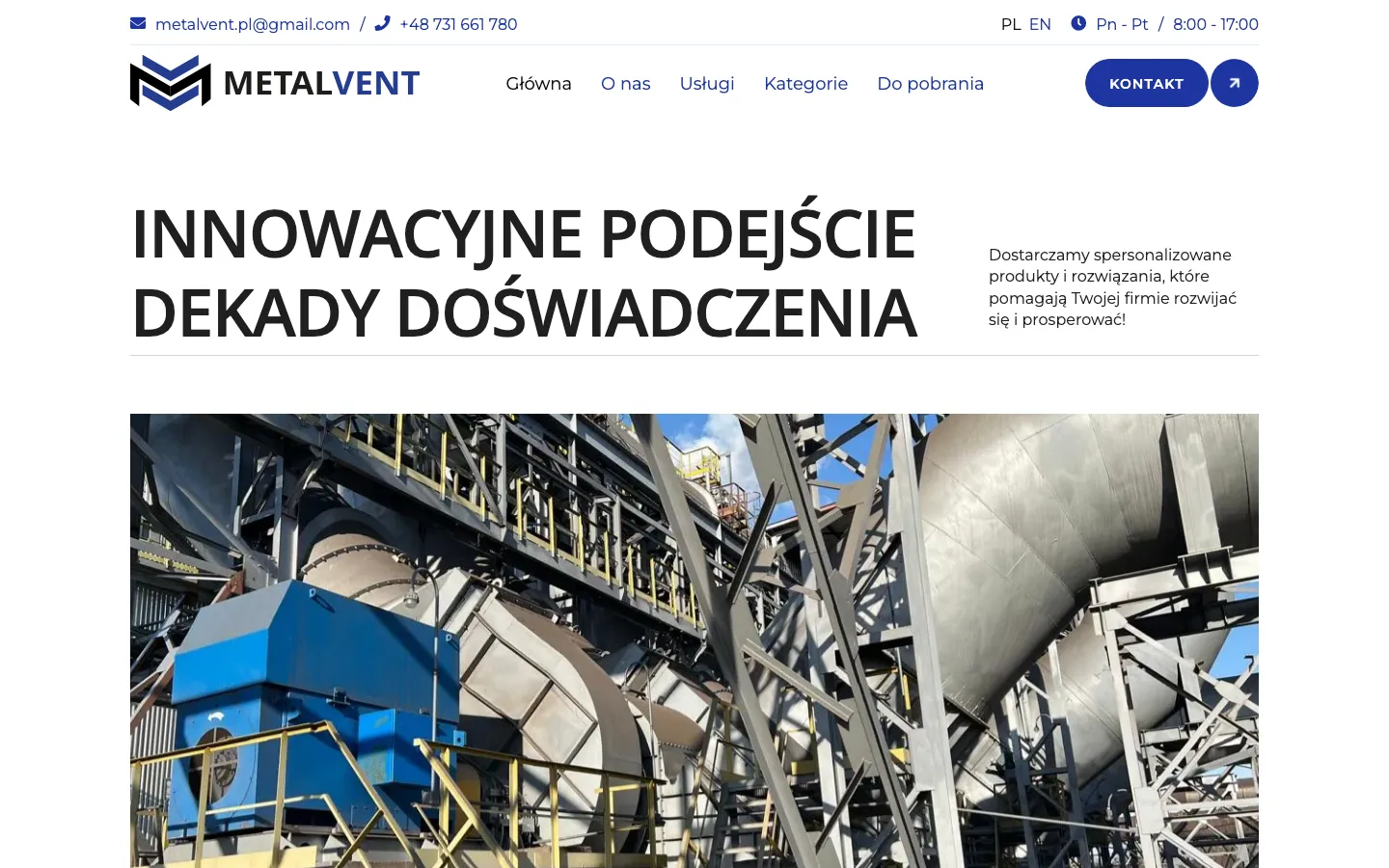
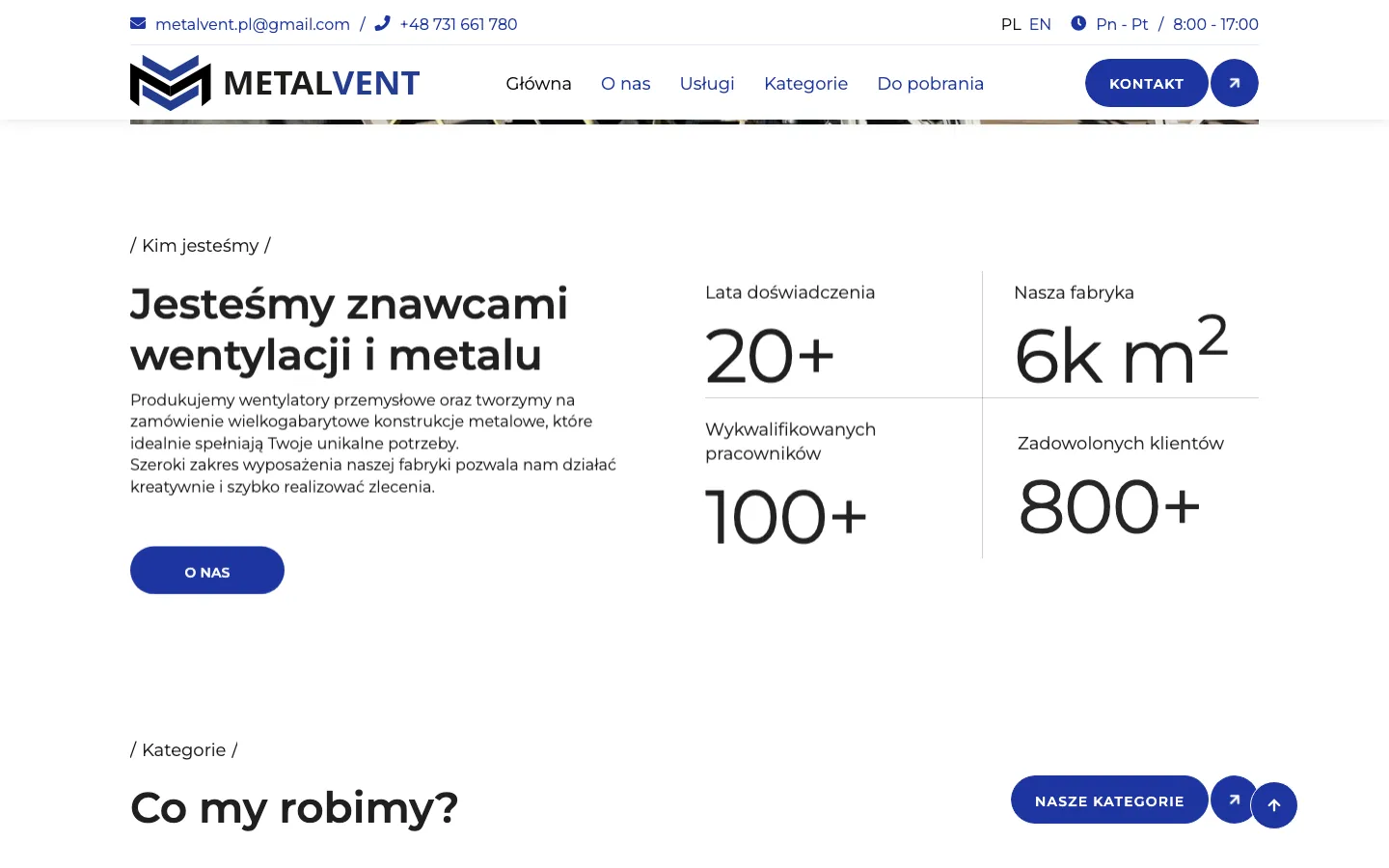
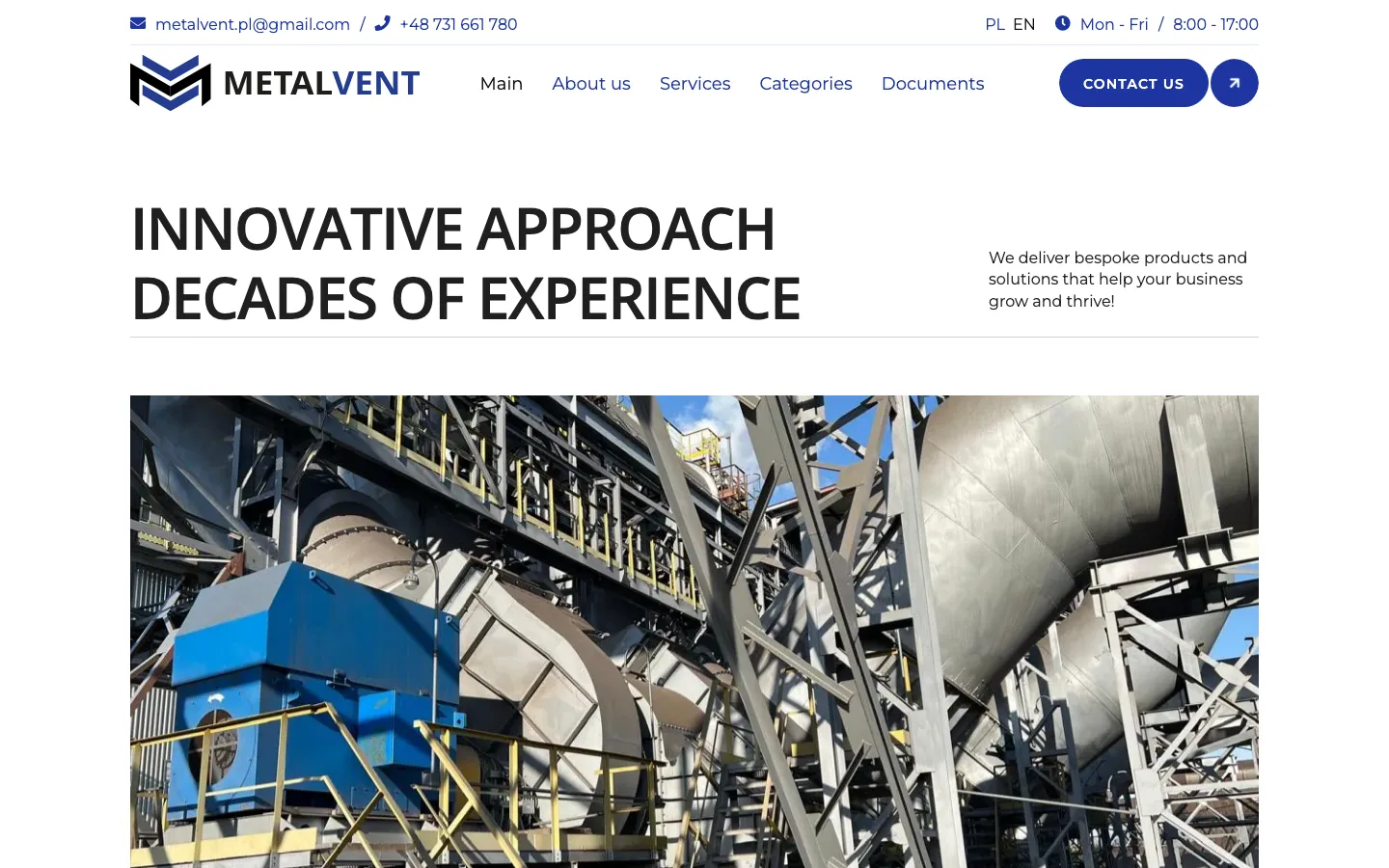
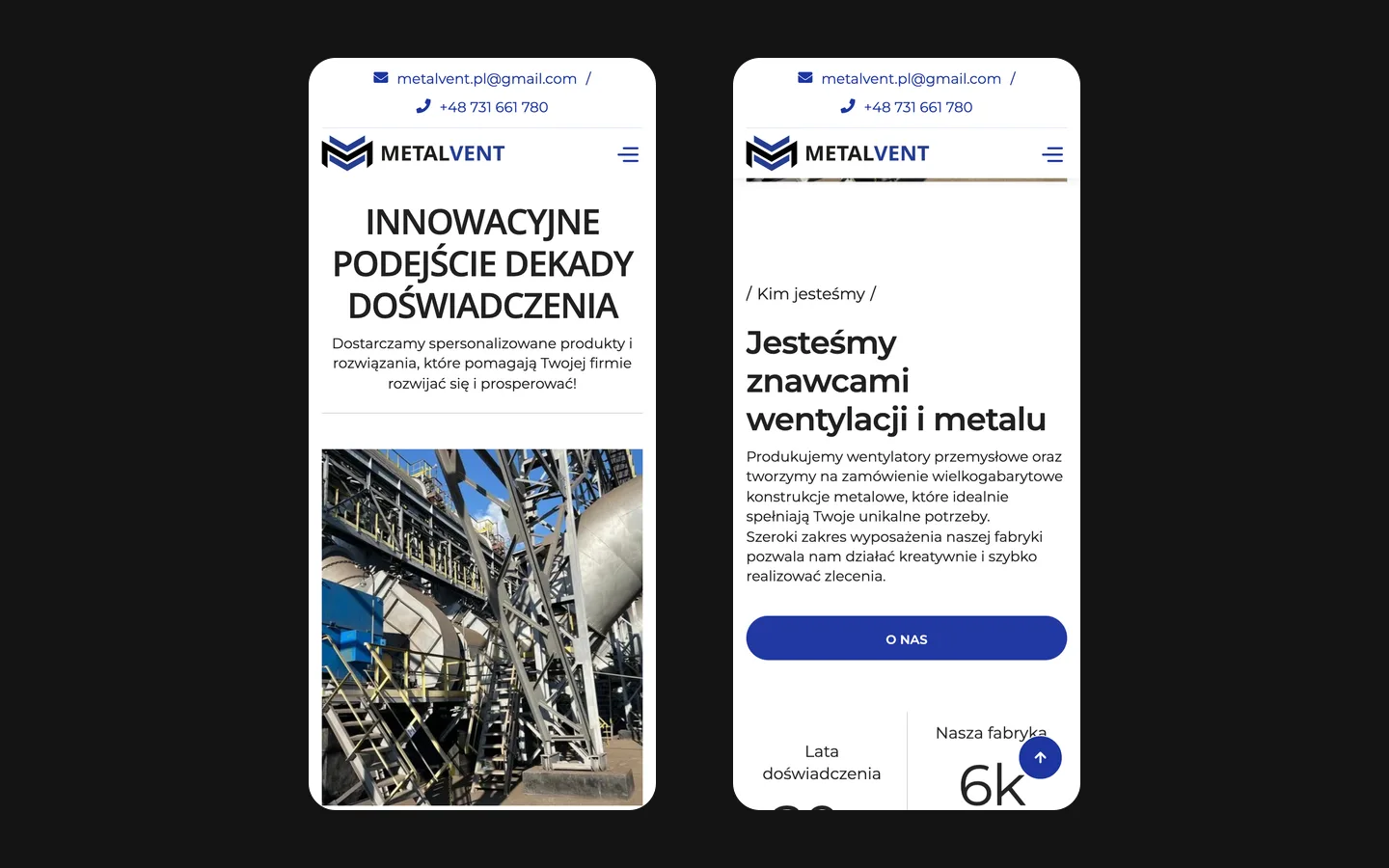
metalvent.plMetalVent website preview
PL + EN

A Polish catalogue with a full English version, switched from the header. checked on the live site · Sep 2026

Six weeks to launch

First message to a live bilingual catalogue. project record

Client-run since launch

Categories, products and downloads edited by the company without a developer. checked on the live site · Sep 2026

The project

Task, approach and delivery

The task

Buyers of industrial ventilation read specification sheets and downloads, not slogans. The catalogue had to be exact and fast to navigate.

The brief moved fast: six weeks from the first message to launch, with a client who checks URL structure personally.

The approach

We pushed back when the client wanted more categories: four product groups fit cleanly into one block, and a buyer should not hunt through a menu. The simpler structure was tested on the client’s own customers and kept.

Built on Webflow with categories, products and downloads as collections, in Polish and English, and handed over to the company to run.

What we delivered

A Webflow catalogue in Polish and English with about, services, categories, downloads and contact, run by the client since launch. Domain and hosting in the client’s name.

A product catalogue that supports a technical buying decision

MetalVent's website connects an industrial product range with documents, manufacturing services and a route to the company. The project record describes a bilingual Webflow build and a handover to the client's team. The important design problem was helping a buyer find the relevant family of equipment without requiring them to understand the manufacturer's internal organisation first.

A catalogue and a manufacturing enquiry serve different purposes

A visitor who already knows the type of fan they need can start with a product category. Someone looking for a metal structure made to a drawing has a different question: can this manufacturer handle the work, and what information should be sent for an initial conversation? The public site gives products and services separate entries. That distinction matters because a list of standard equipment does not explain how to commission an individual manufacturing job.

The homepage currently introduces the company, presents product categories and explains services. It also provides access to downloads and contact details. These are complementary forms of evidence. A photograph helps identify the equipment; a document supports technical checking; the company information provides context for choosing a supplier. None of those elements alone can establish whether a particular installation is suitable. The final technical selection belongs with the manufacturer's specialists.

This is why a manufacturing website needs more than a large hero photograph followed by a request form. A useful enquiry usually follows some initial checking. If a visitor cannot identify the relevant product family or find supporting information, the company receives a less specific question, or no question at all. The design should make that initial research possible without turning the site into an engineering selection tool it was never commissioned to be.

Three layers of information

Product family
The category name establishes where to start. It should use terminology understood by actual buyers and distinguish products that require different selection criteria. A general label such as industrial solutions would make the visitor interpret the range before comparing anything. For a similar project, we first organise a representative sample of real products rather than filling a menu with speculative categories.
Product detail
Within a family, the reader needs a consistent way to recognise an item and check its available information. A photograph, model reference and document should refer to the same product. Which parameters belong on the page must be decided with the manufacturer. A designer should not infer operating conditions or suitability from an image, nor turn an unverified statement into a prominent specification.
Supporting document
A downloadable file can carry detail that would be awkward to read in a short overview. Its label still needs to explain what the reader is opening. In a new catalogue we agree who supplies the file, checks its version and replaces it when the product changes. A download button is only useful when the attached information remains current and matches the product being discussed.

The live catalogue has evolved since the initial structure

The project notes describe an early decision to simplify the category structure and test it with the client's customers. That is evidence about the design process at launch, not a reason to freeze the catalogue indefinitely. The public homepage checked in September 2026 now lists ten product categories. Describing the current website as a fixed four-category catalogue would therefore be inaccurate.

For an industrial business, growth in the catalogue is normal. The useful question is whether a buyer can still recognise the grouping and reach the right information. Adding another product should not require inventing an entirely different page layout; adding a genuinely different product family may require reviewing the navigation. The editorial structure should leave room for both without assuming that fewer categories are always better.

The documented Webflow implementation separates categories, products and downloads into editable content. This gives the client's team a defined place to maintain the range. It does not remove the need for someone inside the company to own the information. A technically editable catalogue can still become unreliable if no one checks old documents, obsolete products or inconsistent naming across languages.

Preparing a bilingual industrial catalogue

  1. Collect a representative product set

    For a comparable project, start with several real items that cover different families and document types. Include an individual manufacturing service as well as catalogue products. This reveals which information can share a structure and which needs a separate explanation. Missing information becomes visible before dozens of pages are designed around an incomplete sample.

  2. Agree terminology and language ownership

    MetalVent has Polish and English versions. In a similar build, technical terminology needs a reviewer who understands the equipment and the intended buyer. Decide which names remain unchanged, which descriptions need translation and who checks the files. Translating navigation alone is insufficient if the buyer reaches a product page with unclear references or documents in an unexpected language.

  3. Test the route to a useful conversation

    Ask a reviewer to find a particular product family, locate supporting information and identify how to discuss an application with the company. Then repeat the task in the other language and on a phone. This tests a complete buying task, not just whether menu links open. These are suggested acceptance tasks for a new project, not a claim that every later version of this client site has been retested by us.

What to bring to a similar project

Bring the current catalogue, a sample of approved technical files, the languages you need and two or three typical customer enquiries. Those enquiries show which facts the sales team repeatedly has to request. We can then decide which information belongs on a public page and which should be discussed directly. Confidential drawings and customer details are not needed for the first estimate; a description of the workflow is enough.

Also name the person who will maintain products after launch. Their routine influences the CMS structure and handover: updating a document is a different task from creating a new category. If the business needs stock synchronisation, automatic quotations, a dealer area or engineering calculations, those requirements must be scoped separately. They should not be assumed to exist simply because the site is called a catalogue.

The verified outcome here is a published bilingual catalogue and an editable content structure described in the project materials. The six-week delivery period is specific to this project and its circumstances. It is not a standard promise for every industrial website, and no sales uplift is claimed without measurement. For a new catalogue, the next step is to define the range, documents and enquiry process, then agree the design and implementation scope against those materials.

What the site does

Project features

  • Exact

    Categories named the way buyers name them; downloads per product.

  • Simple to navigate

    Recognisable product groups with direct access to the relevant catalogue section.

  • Two languages

    Polish and English for domestic and foreign buyers.

  • Run by the company

    No developer needed to add a product or a document.

“It came out really well, I like it a lot.”
MetalVent · Manufacturing · Industrial ventilation (Poland) · translated from the original

Originalдуже класно вийшло, мені дуже подобається

Questions

About MetalVent

How long did the MetalVent catalogue take to build?

Six weeks from the first message to a live bilingual catalogue on Webflow, which the company has run on its own since.

What languages is the MetalVent site in?

Polish and English, with the English version as a full set of pages switched from the header.

Why did HeadPills argue for fewer categories on MetalVent?

Because four product groups fit cleanly into one block and a buyer should not hunt through a menu. The simpler structure was tested on the client’s own customers and kept.

Start a similar project.

Tell us what your site has to do. A short call, then a fixed price in writing.